Monday, September 4, 2023

Alistair Maclean's Where Eagles Dare: a Series of Plot-Holes Flying in Close Formation. Louis Shalako.

Heidi, Major Smith, and Mary Ellison in Where Eagles Dare.


Louis Shalako


Alistair Maclean’s Where Eagles Dare is one of the most popular war films of all time. I bought the book at about the age of eighteen. I liked Alistair Maclean so much, that I bought every book of his that I could find. Over the course of time I owned, and have read many of them, (some of them, many, many times), but by no means all of them.

Every so often, I search the internet looking for crummy old movies, which I like very much. I watch this film several times a year, as well as Ice Station Zebra, The Guns of Navarone, Force 10 from Navarone, When Eight Bells Toll, Bear Island, Puppet on a Chain and of course Breakheart Pass. There are some I simply can’t find. One or two, I can find them but the thing is unwatchable, either due to poor reproduction or poor sound.

Some of these old films were taken off a television screen with a camcorder, dubbed more than once, and it really shows sometimes. Also, volume is often an issue, if you’re going to upload videos to the internet, for crying out loud, turn up the fucking volume already…we can turn it down ourselves if we have to.

River of Death is just plain bad, Donald Pleasance, Michael Dudikoff and Robert Vaughn, Herbert Lom and L.Q. Jones are unable to save it by mere presence alone. One pretty girl cannot save a bad film, ladies and gentlemen. (Full cast.)

***

As entertaining as the film is, Where Eagles Dare is riddled with plot holes and just plain inconsistencies.

Hopefully the reader understands that as a student of writing, one can learn a lot by attention to detail—a good lesson for any writer or director, then there is a bit of logical analysis, and then there is good old fact-checking.

For example, in the opening scene, a Junkers JU-52 aircraft simply does not have the range to fly from the U.K. to southern Germany, and return. The range is quoted at 620 miles, top speed of 165 mph. Cruising speed would be less. The town of Werfen is a real town, it’s in Austria, part of Germany after the Anschluss, not far from the Bavarian border. At its maximum speed, even if it had the range, you would be flying in enemy airspace for hours and hours at a time. You would have to do it twice in what looks like about twenty-four hours, for they parachute and land in darkness, hang out all day, leave in the night and take off in at least some daylight…

The action takes place before D-Day, in fact the fake General Carnaby was supposedly flying to Crete to consult with his Russian counterparts prior to the invasion, where some sort of coordination, or maybe just notification, would be in order.

Only problem there, is that Crete was not liberated until 1945—a simple statement of fact, which can be checked.

Also, assuming you just stole a JU-52 off a nearby airbase, every fighter and anti-aircraft battery in Western Europe would be looking for that plane, which would be lumbering along at 130-mph or whatever. Your best bet would be to head for Switzerland, and if the plane was simply stolen, there would be no way for Colonel Turner to be there in the final, climactic scene. And why send the Colonel along in the first place? It would be so much wiser just to arrest him while he’s still in England, still at headquarters, where armed people abound, hell, they might even have a cell to put him in. This is the significance of the scene where the Admiral asks, 'do you have it?' as Colonel Turner and the others have been under suspicion for some time. One wonders why they didn't just arrest him and sweat him a little, but then there would be no film...right? At this point, the other enemy agents are expendable and nothing but a hindrance to any escape plan...

Google. 2,292.9 miles.

It gets better. The fake general was aboard a de Havilland Mosquito, which might have had the range for a one-way trip to Crete in the long-range reconnaissance version which was developed for the Pacific Campaign, and they did range all over Europe. The bomber version has a quoted range of 1,300 miles. Launched from Suffolk, the distance to Crete is over 2,200 miles. Riddled with English bullet holes, as Major Smith (Richard Burton) says, it crash landed, conveniently enough, ten miles away at a German military airfield. No mention is ever made of what happened to the British pilot of that aircraft, one supposes the prisoners were kept separated in what is standard operating procedure.

Standard operating procedure is virtually ignored all through this film.

Okay, upon arrival by parachute, which would have made more sense if it had been from a Stirling bomber, or the Halifax, both of which were used by airborne forces, Sergeant Harrod is found dead. Assuming all of the others were wearing the same, standard issue boots, even so, it would have been possible to simply follow the tracks, for surely Harrod himself didn’t make too many. Seven people come down scattered. To rendezvous with the gear, seven (or six, to be accurate) sets of tracks converge on a point. Searching for the missing Harrod, six sets of tracks go out from that point in some kind of search pattern. Bearing this in mind, watching the film, we can see any number of tracks, one of the challenges of filming on location in wintertime. Yet Smith makes no attempt to follow any tracks. Yet he knows that Harrod has been murdered, taking into account all the bullshit about marks on the neck and stuff. Presumably the mission comes first. Presumably, they already have their suspicions of at least some of this crew already...in the film, the next to go is Jock, which tends to indicate his innocence.

Ingrid Pitt as Heidi.

As for Lieutenant Schaffer, (Clint Eastwood in one of many iconic roles), we know he's innocent, as Smith points out he's an American, and brought in for just this purpose...he's untainted by Britishness or something. Right.

Bloody well right...

(Louis is getting ahead of the plot here. - ed.)

The party proceeds to a small farmhouse in a high alpine meadow, seasonal accommodation fairly common in that part of the world. And he says, that while grabbing the radio, he has forgotten the codebooks. He has to go back, theoretically, for he actually did take them, this after sending the party back for the equipment. He goes out to the barn, where he meets the Mary Ellison character, after ordering the others not to leave the building. Yet it seems odd that not one of them ever needs to go the outhouse, for there is no likelihood of indoor plumbing in such a dwelling…

What is interesting is that never, at any time in the film, do they use code. They use call-signs, broadcasting in the clear, “Broadsword calling Danny Boy,” and all that sort of a thing.

Codes are codes. There is such a thing as a spoken code, or word-substitution text codes, but code books were basically a series of numbers, meant to be sent by something akin to Morse code—a series of dots and dashes sent by clicking a momentary switch.

***

We’ll skip over the clear, physical impossibility of leaping off the top of a cable-car and then half-running up a snow-covered roof. It’s a dramatic scene, full of suspense and dread, and yet there is just no way you could do it. Why would you, when you could just get some forged documents and ride up inside the cable-car, just like everybody else.

The whole premise of the film is bogus. A lie can be just as revealing as the truth, and this guy is supposed to allow himself to be tortured, according to Smith, into revealing false plans for the Second Front. I also find it difficult to believe that anyone, including a second-rate actor, would volunteer or allow themselves to be inveigled into undertaking such a mission. No one has that much faith, no one—as operations go, this one is awful hairy. Think about it: you are under torture. You have fake plans for D-Day. You most emphatically do not have the real plans for D-Day. How far would you push your luck? Right about the point where they're going to slice your pecker off, that's where.

It is true that a successful disinformation campaign was carried out prior to D-Day, much of it involving fake radio traffic, which emanated from the U.K.

Prior to the invasion of Sicily, (see The Man Who Never Was), there was an operation to convince the enemy, Germany and Italy, that the next invasion would be of the Balkans—rather than Sicily.

***

Der Schloss Adler. I bet there's a road, ladies and gentlemen.

Radio rooms. Once inside the castle, Smith and Schaffer take a look, Smith says they must disable the helicopter…Schaffer kills the guy in the Funkraum, (German for radio room), while Smith goes out and finds the helicopter pilot. There is literally a sign on the wall, this is for the audience to know its a radio room. He tells him there is a phone call, directing him to the Funkraum (radio room in German), just around the corner, where Schaffer stabs him. All very well, but the equipment in no way resembles a telephone switchboard. There would be an internal switchboard, connected within the castle. Outside lines would go through a switchboard down the mountain in the village.

I may tend to jump around in this analysis, if one has seen the film, you should be able to keep up, if you’ve never seen the film, then reading this post is essentially useless. There is a lot to cover, and I may not be able to hit every little thing.

Road work. The car accident. One wonders why three prisoners were taken to the castle via the cable car, whereas Smith and Schaffer were taken by car, which leads to the car accident scene. One wonders why their hands were not bound, when Schaffer moves to ‘tie up his shoelaces’, for example. One wonders what kind of road work, in the middle of winter, involves a piddly little cement mixer, or a few boards leaning up against the cliff, or various little racks that just stand there. There are two piles of gravel and some road barricades…after going out of control, the car goes up and over the first gravel pile and then crashes into the next one. Yet somehow, they manage to push the car back far enough, turn the wheel and then send it over the cliff. Now they walk back to town. All of this leads up to the question of where exactly does that road go…??? Presumably the castle. This just brings us back to question of why use the cable car at all. With good forged documents, the odds are, senior officers would have been admitted at the gate, even if they were unexpected. Truth is, they would have been brought in and then checked out very thoroughly. If the road does not go to the castle, just where in the hell were they going. A contradiction, if you will.

Himmler’s brother. When the six survivors arrive in town, stash their packs and enter zum Wilden Hirsh, (German for wild stag or wild hart), Smith informs another German officer that he is Himmler’s brother. This is about as stupid as it gets, ladies and gentlemen. A public figure in his own right, he might have been recognizable to anyone that read a newspaper, especially considering his older brother, but also as well as his employment at Berlin Radio.

Anti-aircraft gun in courtyard. This is more a matter of detail. With thirty or forty-foot curtain walls, the field of fire is severely restricted, and this weapon really should have been put up on the walls, or even outside the building, on a nearby hilltop, overlooking the valuable target it is meant to protect.

S.S. versus Gestapo. I became curious, as I often do. The Gestapo did indeed have a full-dress military style uniform. The average Gestapo in the civilian street really did wear the long, brown leather coats and various civilian attire. The psychology of a Gestapo officer wearing a uniform while surrounded by other military types is pretty obvious, it was meant to show rank, status, and perhaps to be taken seriously when surrounded by senior German officers. As far as that goes, there might not be too much love lost between S.S. and Gestapo, service rivalries being what they are in any army past and present.

***

The so-called proof. This is where the second radio room comes in...once we get to the scene in the great hall, where the assembled guests are comfortably seated around the table, with General Carnaby, soon to be revealed as Corporal Cartright-Jones, once we get past the fact that his hands are not bound, a clear violation of standard procedures, there is the question of so-called proof. This is when Major Smith suggests that the Germans have ‘one of the most powerful radio-telephones in Europe’ and that they contact Wilhelm Wilner in Italy to confirm his identity. One, the operator in the first Funkraum is dead, along with the helicopter pilot. Two, no one has discovered the bodies, and if this is indeed the telephone room, one wonders why no internal phone traffic, in what is purported to be the headquarters of the S.S. or Gestapo in southern Bavaria. How come no off-duty troopers use their privilege, pay the tolls and make a quick call home to the wife and family. But now, we see the need for a second radio room. That guy hasn’t been killed yet, right? And they obviously can't use the phone in the regular fashion. They're using the 'radio telephone', a real thing which actually did exist in WW II, referred to by British types as the r/t in many a book and film. Would it be possible to patch a phone line into the inputs of a radio set? Presumably, yes. The castle is described as the headquarters of the German Secret Service in Bavaria, yet seems to be populated with uniformed officers of the S.S. and Gestapo, and down below is a training camp for what are likely mountain troops...details, details.

#details

As far as the actual proof, it is of course ludicrous and no self-respecting senior officer would ever take it at face value. The very fact that two unknown officers come tramping down the stairs and into the room, unannounced, would have been something of a dead giveaway. Also, telling the enemy anything is bad practice. Yet the Germans bring in three spies to impress Carnaby, and Smith admits he’s been feeding bad info to Willi Wilner in Italy.

The poster.

There may be more, (maybe even plenty more), but you get the flavour of it. I have fantasized on occasion, of trying to find every Alistair Maclean book, perhaps in the thrift stores or buying them on Amazon. River of Death might be better enjoyed as a book than as a bad film, for example. I would love to read some of them again, that is for sure, ladies and gentlemen.

Films of this era have good colour, there are no computer generated images. Sets, vehicles, weapons are period, the locations are good, the acting is good, the budget was adequate. The pyrotechnics are good. It’s got a lot going for it, don’t get me wrong. Some guys like the Heidi character, for a couple of pretty obvious reasons. I like the Mary Ure character, but then I’ve always admired a girl that can shoot—that one’s more than just a pretty face.

Fighting on top of a cable-car is just plain nuts, yet the scene is reprised in Moonraker, with Bond and Jaws, and of course Doctor Goodhead—a real bad name, but Ian Fleming was famous for that sort of thing.

The film is fun, full of eye-candy for the war movie buff. In so many respects, it is a very good film and probably one of the best, for war movies fall down so very, very often...that, is a story for another day.

Other than that, you can learn much from almost any film, good or bad, if you have a jaundiced eye and a penchant for writing. One of the reasons I wanted to write in the first place, and this is not a thing to say lightly: because so much of film and television was just bad, ladies and gentlemen. That was true back then, and I reckon it’s still true today.

Notes. What was the German Secret Service. The answer is complicated. Heydrich and Himmler had their own ideas and their own empires to build, but the Abwehr existed until the assassination attempt of July 20, 1944, after which Hitler did away with the Abwehr, and Admiral Canaris and Colonel Oster ended up in concentration camps, ultimately murdered in the most cruel and obscene ways.

See: Sicherhietsdienst.


END


Louis Shalako has ebooks and audiobooks available from Google Play. Some of them are presently free, for example On the Nature of the Gods.

Louis has some artworks on ArtPal.

My First Pho. See this story on the #superdough blog.


Thank you for reading.


Thursday, May 25, 2023

Producing Audiobooks Using Artificial Intelligence: beta mode. Louis Shalako.

She can be trained...


Louis Shalako


A few notes on producing audiobooks, narrated by AI, on Google Play.

This feature is free while it’s in beta mode. I was uploading my new novel, A Stranger In Paris, an Inspector Gilles Maintenon Mystery #9.

It took three winters to write that thing, and I won’t say I was in a hurry—

As soon as I signed into the website, I saw the big blue button. Create an auto-narrated audiobook, click here.

Hmn. Interesting, I thought—

We will check that out later.

It clicked in after a while that they might be charging money for that, as soon as it goes into regular mode.

With 150 titles on Google Play, full-length novels, novellas, collections, short stories, this represents something of an opportunity. And early adopters often reap the greatest benefit from new technologies.

***

You have to read around in there, you sort of have to experiment. And yet, this is my book—but you have to take some risks. The ebooks are well formatted. The POD interiors are good, although I have yet to crack the code in terms of getting a cover uploaded on Lulu (dot) com, for example.

Okay, so your cover should be square, (not a regular portrait shot) and on the first couple of uploads, I went to the trouble of modifying the original ebook cover. Yet in the trouble-shooting phase, I read that Google Play will ‘letterbox’ your original image. Why make it square when you can just use the original marketing image. (Downloaded in full size from Smashwords. - ed.)

Also.

(If you’re just starting off and you have a small number of titles, you may want to do the work, but also, keep on going in the same manner. – ed.)

He’s right. Consistency is good. #Louis

***

Front matter. This tends to be repetitive, with a title page, a copyright page, your name in there twice or three times over two pages and a small number of words. I’m trimming that down to the minimum, also the author needs a unique ISBN number for each additional format, for every single product. You can get them from Collections Canada ISBN service, free to any Canadian citizen.

Okay. My book has chapters, my shorter works have scenes, acts, or whatever. In an Epub ebook, in order to get maximum distribution through a platform like Smashwords, you need internal navigation. You have a Table of Contents, which is in text, followed by a bunch of links to individual chapters. All of this is simply ignored. The links disappear, but you have to delete Table of Contents, which is merely text. Creating a credible audiobook, even with the help of the tool of AI, turns out to take some effort after all…you have to listen to every word. An audiobook can go six hours of listening time, and fixing things drags that out even longer. In my case, it would have been smarter to start with the absolutely shortest stories on the list.

***

Okay, so front matter, and end matter, that can be deleted or rewritten. For example, my bio also has a link to my blog. The bio remains, in the audiobook interface on Google Play Partner Centre, but the link is gone, what remains > Louis Shalako < (exactly as it appears. – ed.) remains. Again, this should be removed.

I should go back and check and see if the machine says ‘The End’ at the end of the book…

***

Editing. As for editing the actual text. "Hmn." will render as H-M-N, heh-heh-heh suffers a similar fate. Hyphenated words, for the most part, have a funny cadence and so now I'm taking out hyphens, one at a time...Chapters are deleted, so I put the cursor on the first line of text and bump that down, go back up, type in Chapter One, etc., then the machine will read it properly. You can adjust speed, you can pick voices, which are kind of limited in English. There are several other supported languages, and this is when it becomes all the more impressive, in terms of automation and AI.

So, having learned this much, it seems one should go back and review the first few audiobooks I have produced. That being said, the Google Play AI reads the text fairly well. The learning curve, as always, is fairly steep in the early stages.

I've tried changing the pronunciation of my name, which is not good. I have been unsuccessful.

I’ve learned a hell of a lot in the last two weeks, one could safely say. The machine has its limitations, but then so do I. So do we all.

Louis will crack the code.

#experimental

I had one book that just would not go yesterday, I tried again today and it still won’t go. I have no idea of what is wrong, and yet I am reluctant to chat with Google. Yet I’ve uploaded a dozen, converted them, and hopefully they are relatively good products.

The Bio.

It seems like you can update your bio, yet it’s not immediately evident on your first pass. I’ve published, and seen the product go live, and yet I seem to have skipped past the part where you select a genre, and put in the author’s bio.

You can’t get the book to go live without setting a price, yet you can mess around on the page for some time. A book should go live within 24 hours, my typical experience is ten or fifeen minutes at most.

Analysis.

Okay, so in beta mode, staff are working to perfect the thing and I’m working to perfect my thing. They must be learning a lot as well, and as long as it’s free, why not jam up as many titles as possible while the going is good. I can always go back later and fix things, I routinely do quality control and yet that is one big project for another day.

The full (hyphen) length books would be labour intensive, to say the least.

In a recent comment on Facebook, someone called AI ‘plagiarism software’. I cannot plagiarize myself. I own all copyright on products created using the tools otherwise known as AI.

AI would have been trained on the same open-source resources you and I also have access to, namely books, news sources, encyclopedias, as well as large spoken-word sources of a similar nature. They train it, (you and I train it), using music, and pictures and video and any number of other sources.

In that sense, it is ‘learning’, or being trained, and who knows where all of that is going to go. As for myself, I figure I can defeat any system by using its own rules against it.

I will try and stay ahead of it.


END


Formatting A Stranger In Paris (ebook).

Experimental: Artificial Intelligence.


Poor old Louis has books, stories and yes, ladies and gentlemen, audiobooks on Google Play.


See his works on ArtPal.


Thank you for reading.


Wednesday, May 10, 2023

Experimental. Artificial Intelligence and Audiobooks. Louis Shalako.

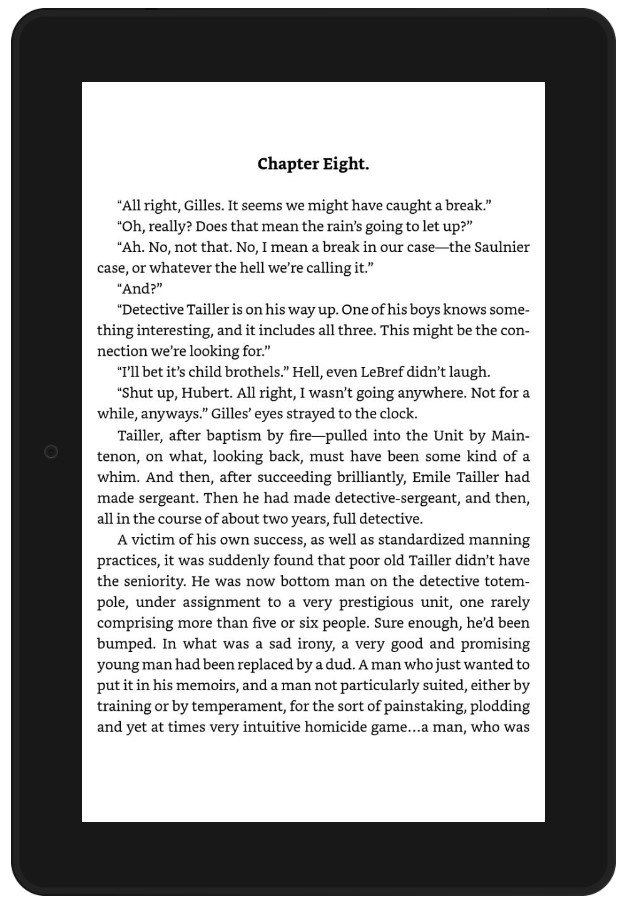
The ebook preview feature on Kindle Direct Publishing.


Louis Shalako


Okay. Ladies and gentlemen.

So, I am uploading and publishing A Stranger In Paris, Inspector Gilles Maintenon Mystery #9, by Louis Shalako.

Those will be in multiple ebook formats as well as a couple of different sizes of paperbacks from print on demand publishing sites.

Things have changed in the six years since I last published a book in ebook and paperback.

It’s a bit of a learning curve, I have problems with a cover here and a glitch in the formatting there. A bit of a learning curve. (In other words, fuck, ladies and gentlemen. - ed.)  Like many such learning curves, there are the odd rabbit holes and unexpected opportunities that might be exploited. It is also possible to get side-tracked and confused, to lack focus and lose sight of the ultimate goal, which is to write books and stories, have fun, and if possible, make a bit of eating money...all these publishing platforms have preview features, and KDP revealed one line, Chapter Thirty-Three, that was in a different size and font. I do not want to publish an ebook or paperback with one line in a different size and font, ladies and gentlemen. I did manage to fix that…

We're in the quality control stage.

***

I downloaded 'TotalEbookViewer' and it's not very good. I signed into Nook, looking for Nook for PC. The site directed me to the Microsoft Store, who (or which) does not appear to have it. I had it at one time, maybe I should search my own computer for it. I don't know, it just didn't look very nice and I am checking quality control on a new book.

I also downloaded Kindle, epub and PDF files from Smashwords. The PDF looks good in Kindle Reader for PC. Kobo accepts various formats, unfortunately not PDF. I don't think Kobo has a preview feature for ebook uploads, which is unfortunate. (Turns out they do. - ed.) My POD text looks fine in the Lulu preview. Getting a paperback book cover through there may be a little more challenging, even though I have done a few before. I'm saving KDP for last, as they are the biggie and that is where the greatest sales potential is because of the vast volume of traffic. It is also where you have the greatest competition, which means the readers are swamped for choice.

This is my book on the Lulu POD preview. It looks okay.
***

When publishing, I like to preview every page, and I have provided some pics of what that looks like.

I just converted to an audiobook on Google Play. It sounded surprisingly good for what I take to be AI. I saw that new option when I went to upload my new book. Once I got that done, I went back and had another look.

Here’s the thing. I have one hundred and fifty titles on Google Play, novels, collections and short stories, under five different pen names and in all kinds of genres.

All of that potential...revealed.

All I really hoped for was to finish my twenty-third novel, which took three winters to write and over which I have slaved and sweated and yeah, whatever. All one has to do is to click on a few buttons. All one needs is a fresh ISBN number for each new audiobook. All one needs is to find the original ebook marketing image, which seems to work well enough for an audiobook. All of a sudden, one has doubled the number of products, all of them available for the occasional customer to take a shine to and maybe spend the money.

This is Artificial Intelligence, possibly exploiting me but also a bright, shiny new tool, one that however briefly, can leverage my own productivity.

Those books and stories are already written. They already exist—all I have to do is to pick a voice, set a price, listen to a few short sections, edit some of the front matter, which is repetitive and not necessary.

All I need is a bit of time, a bit of time away from the regular, part-time job and running errands about town.

We'll see what happens with all these audiobooks, ladies and gentlemen...
***

Smashwords has epub downloads in something called ReadAloud, and I did download that (A Stranger In Paris), and I did listen to it. It’s not very good, which is why Google’s voices (and you can choose from several), kind of surprised me. With a long list of titles, I can use a female Aussie voice, for example, on a Constance ‘Dusty’ Miller story and a young American male voice for an Ian W. Cooper story.

It looks like I have my work cut out for me, what with all those ISBNs and cover images crowding my desktop and filling up my file folders.


END


Poor old Louis is on Google Play along with some pen-names.

See his art on Fine Art America.

Check out this other story here.


Thank you for reading.


Tuesday, May 2, 2023

A Stranger In Paris: Formatting Ebooks and PODs. Louis Shalako.

An ebook marketing image does not have a 'trim area'.


Louis Shalako 


On formatting A Stranger In Paris, Inspector Gilles Maintenon Mystery, #9.

I have page numbers for the text, none in the front and end matter. I have the simplest of headers. I may fool with the size, font, and in previous books I have had that in dark grey rather than black. I may make the page number bigger or bolder. It took some fiddling, as I hadn't done page numbers in about six years. Now that the fucky part is done, now I go through and justify right by scene and chapter, without disturbing the centering of chapter titles and scene breaks. The bulk of the formatting is pretty clean, as the ebook file made it through the Smashwords Meatgrinder on the second try. Ebooks have flowing text, which automatically justifies to the left, with a ragged right edge in your .doc file.

The next stage would be to size that in 5"x 8" and then in pocketbook, (using page size features in Word), which works out to 4.25" x 6.88" approx. The biggest effing challenge is to modify the cover image so the text does not stray into the trim area in the Print On Demand (POD) product. This is not so much of a consideration with the ebook product.

I take the ebook and 'save as' StrangerPOD5x8, for example. (You can have spaces in there, but I never do.)

Close the ebook, open up the new file and that's the starting point for the print product.

Always, at the end of a work-binge, email the latest copy to yourself, this includes covers, blurbs, the original, clean marketing image. All that stuff. You will thank me someday, if you can remember…with Lulu, you can download your original file, with Smashwords as well. 

Very handy when the computer has a meltdown…

It gets to the point where I am edging the text a little further up, a little further down, a little closer to the spine and the edge of the page using 'margins' and stuff like that. The old Createspace viewer had dotted lines showing the printed area. If the text was very much smaller, you were wasting paper on some level, and also producing a funny-looking book with a tiny block of text in the middle of a pretty big white sheet of paper.

The text must never extend beyond those dotted lines.

You are basically just trying to make it look nice and professional.

In a subtle form of protest, I do not use block paragraphs at the beginning of chapter and scene. My first six books were unpublished but heavily-rejected manuscripts and quite frankly I never even noticed. I was doing ebooks exclusively at first, all my own works.

There was no customer to keep me honest or to point out the mistake when I went to do paperbacks.

Pro tip: go to your bookshelf and look at the formatting of a good quality book. Once I realized the error, I just kept doing it. My revenge for 1,168+ rejection slips. In a paperback, I will need to remove the page of links, internal navigation for the ebook. I will need to insert blank pages, but that's pretty much it.

Chapter One should be page one—sometimes you have to mess around with it. I had to choose ‘zero’ for the starting point rather than ‘one’, which will not be immediately obvious to the person doing the formatting. You have to turn off ‘link to previous section’, otherwise front or end matter will have page numbers and my book would begin on page four. That’s just dumb, ladies and gentlemen…

The ebook is loaded up but not published. Why not release them all at once, if I can possibly do it, to Lulu, Amazon, wherever I can get them in print, or ebooks on Kobo and Google Play, for example. Smashwords and Draft2Digital are one company now, and Smashwords distributes ebooks to a number of platforms including Scribd and iTunes.

A blank page to put your autograph on. Okay, that’s a joke, but a sheet of paper has two sides. An ebook can have an odd number of pages, a paperback or hardcover cannot. (An odd number of sheets will still have two sides and add up to an even number of printable pages, blank or otherwise.) I will insert two blank pages, have a title page, the back of that can have the copyright stuff, (front matter), two more blank pages and then it’s Chapter One/page one.

Same thing more or less at the end of the book, which must come out to an even number of pages. I don’t know if this is much help to you, but it actually was of some help to me—after all, it has been six years.


#Louis


END


Louis has books and stories on Amazon, Barnes & Noble, as well as the sites mentioned above.

See his works on Artpal.

Check out this other story.


Thank you for reading.


Saturday, April 1, 2023

A Stranger In Paris, an Inspector Gilles Maintenon Mystery #9, Pt. 34. Louis Shalako.

That's von, Schleischer.


Louis Shalako


Gilles, Andre and Margot, along with Alphonse and Doctor Poirier, stood around the pull-out drawer containing the corpse. The doctor picked one—

“Andre. Is your gender important to you?”

“I never leave home without it.”

The doctor grinned.

It was all very mystifying, but he’d insisted that they come down, anyone, really, and have a look for themselves. He wasn’t going to tell them otherwise, and he might not even send them a report…the pictures would be lurid indeed, as he had said on the phone. It had been enough, curiosity being what it was.

Piling into the car, they’d headed for the morgue.

The photos also required some interpretation.

The young doctor reached for the white shroud of the cotton sheet, bleached this one too many times, oddly, pulling it up feet-first in some aberration from accepted tropes…

“Ah.”

They stared.

“This individual has not been circumcised.”

Poirier pulled it off the rest of the way.

“Well. There you have it, then.” He cleared his throat, eyes magnified by the thick glasses as he stood regarding his attentive audience. “It is extremely unusual, at least according to the literature, to have such a full and complete development of…well, of both sets of sexual organs.”

He’d never seen one before, although apparently there was a certain small percentage of the human race born with the condition.

“There is even some vestigial development of the mammaries, which tells us something about the glands and the, ah, hormones…you have to understand the hormones and all of that sort of thing.” They stared. “Also, the body is relatively hairless. This includes facial hair, not so much pubic hair or in the armpits. Bearing all of this in mind, it is indeed quite possible, with the aid of wigs and makeup, for this person to have passed as a woman. I mean, let’s face it. A man, clean-shaven, with minimal makeup, dressed as a woman, might very well be able to walk into the ladies room, sit in a cubicle, and urinate or defecate, and no one would ever be the wiser. There are plenty of ugly women in the world. This might be quite handy under certain circumstances, that ability to bend their gender and go almost anywhere at will. And then there is poor old Gilles, looking in the wrong bathroom.”

Then, according to him, as they all stood there open-mouthed, there were the psychological aspects of such a person, engaged in such-and-such an enterprise, or almost any enterprise.

“Statistically, one-point-seven percent or so of all human beings have some sort of intersex trait, and half a percent have a clinically observable, physical, sexual or reproductive variation. I mean that in the sense that it is quite different from classic homosexuality, which as we know nowadays is more of a psychological manifestation.”

He looked up happily.

“I’ve never even seen one, myself, although Doctor Auger said he’s seen two or three. I’ve seen diagrams in a textbook and that’s about it. Quite frankly, I’m taking lots and lots of pictures, and dissecting very carefully. I’m thinking of writing a little monograph on the subject…”

The doctor cleared his throat and went on.

“Daily living might have been very different for such a person. Difficult, even. Knowing from a very young age, that they were somehow, shamefully different. Keeping it a secret, from friends, in school, from the neighbours and the church and the employers, and finally, the political party. To experience the shame of one’s parents and siblings. That look in grandpa’s eyes…when you walked into the room.”

He had a captive audience, that was for sure.

“This person would have wanted to be accepted, above all else—”

"...just trying to stay out of a camp, when you think of it..."

There weren’t too many ways to do that, except to be more ignorant, more cruel, more vicious than the next Nazi.

“They would have wanted to be loved, more than anything, and yet. I would bet, that this person could not love themself…”

All of those youth groups. All of those regimented activities—regimented by the state. To have such a secret, in such an environment, well, it might have warped them pretty badly, as the good doctor put it. More than anything, just trying to please, maybe even just trying to get ahead. Just trying to survive, dignity intact, a lot of the time. Just trying to stay out of a camp, in the final analysis, what with the euthanization of what the Nazis saw as cretins and cripples and deviants. What kind of relationships this person might have had, were anyone’s guess.

“It would be extremely difficult, to have any kind of really close, physical relationship, one that was not abusive or exploitative…”

Someone, with an otherwise pretty good mind, tall, athletic, good-looking. The perfect ubermenschen, if only they hadn’t been so very, very imperfect. Imperfect in the sexual sense.

“That’s right, ladies and gentlemen: poor old Schleischer was a Nazi hermaphrodite.”

He cleared his throat.

“Sorry, ladies and gentlemen…von, Schleischer, that is…”

They broke up in laughs, as he had expected that they would.

He stood there, oblivious to the pink stains on his white apron, and he took a moment to pull off the surgical gloves.

All of this would be in the written report.

End.

                                                           About Louis Shalako


Louis Shalako is the founder of Long Cool One Books and the author of novels, novellas and short stories. Louis studied Radio, Television and Journalism Arts at Lambton College of Applied Arts and Technology, later going on to study fine art. He began writing for community newspapers and industrial magazines over thirty years ago. His stories appear in publications including Perihelion Science Fiction, Bewildering Stories, New Myths, Aurora Wolf, Ennea, Wonderwaan, Algernon, Nova Fantasia, and Danse Macabre. He lives in southern Ontario and writes full time. Louis enjoys cycling, swimming and good books.


Chapter One.

Chapter Two.

Chapter Three.

Chapter Four.

Chapter Five.

Chapter Six.

Chapter Seven.

Chapter Eight.

Chapter Nine.

Chapter Ten.

Chapter Eleven.

Chapter Twelve.

Chapter Thirteen.

Chapter Fourteen.

Chapter Fifteen.

Chapter Sixteen.

Chapter Seventeen.

Chapter Eighteen.

Chapter Nineteen.

Chapter Twenty.

Chapter Twenty-One.

Chapter Twenty-Two.

Chapter Twenty-Three.

Chapter Twenty-Four.

Chapter Twenty-Five.

Poor old Louis has been watching too many old movies.

Chapter Twenty-Six.

Chapter Twenty-Seven.

Chapter Twenty-Eight.

Chapter Twenty-Nine.

Chapter Thirty.

Chapter Thirty-One.

Chapter Thirty-Two.

Chapter Thirty-Three.


Louis has books and stories on Smashwords.

See his art on ArtPal.

Check out this other story here. Temple of the Jaguar God, by Zach Neal.


Thank you for reading.