Showing posts with label authors. Show all posts

Friday, June 13, 2025

Broadsword Calling Danny Boy: on Alistair MacLean. Louis Shalako.

"Broadsword calling Danny Boy."


Louis Shalako


On Alistair MacLean.


I was just watching the 1979 film of Alistair MacLean’s Bear Island.

It has been said that the quality of his work was uneven. You could say that about any writer, if one compares the first thing they ever wrote against the last thing they ever wrote, along with some of the really great stuff when they were at their peak. Of course their work was variable, and so is mine and so is yours.

Author John Creasy wrote something like six hundred books, and there are a few in there, which I have read, where one wonders how it actually got published in the first place. Truth was, he was grinding them out relentlessly, at the dining room table, and trying to feed a family, when the going rate for a novel might have been a measly twenty-five pounds.

(How in the hell do you even do that? - ed.)

There is a big difference between six hundred books and twenty or thirty, that difference is the luxury of time.

I wanted to talk about Alistair MacLean due to the number of films that were adapted from his works.


First, a little background.


“In 1941, at the age of 19, MacLean was called up to fight in the Second World War with the Royal Navy, serving with the ranks of ordinary seamanable seaman, and leading torpedo operator. He was first assigned to PS Bournemouth Queen, a converted excursion ship fitted for antiaircraft guns, on duty off the coasts of England and Scotland. Beginning in 1943, he served on HMS Royalist, a Dido-class light cruiser. There, he saw action in 1943 in the Atlantic theatre, on two Arctic convoys and escorting aircraft carrier groups in operations against Tirpitz, and other targets off the Norwegian coast. He took part in Convoy PQ 17 on Royalist. In 1944, Royalist and he served in the Mediterranean theatre, as part of the invasion of southern France and in helping to sink blockade runners off Crete and bombard Milos in the Aegean.” (Wiki)

Where Eagles Dare consistently ranks among the top five war adventure films of all times, and that’s pretty good company to be keeping for any writer. The Guns of Navarone is an acknowledged classic, one I have viewed many times. Force 10 from Navarone, another classic film.

Alistair at about twenty.

In terms of comparisons, River of Death is quite terrible, at least in the film version. And I have read the book, in fact I used to check for new titles at our local mall book shop, way back in the days when we had time, money, and plenty of hair on the old noggin…a leather jacket and a seventeen-hair mustache, if you really want to know.

Fear is the Key, this film has one of the best car chase scenes ever. What might have been described in the book is fully brought to life in this one. MacLean loved sending things over cliffs, for example vehicles in Where Eagles Dare and Guns of Navarone, as well as Bear Island. There are probably others, and this is one reason why they’re called action-adventure stories. Oh, yeah. In Breakheart Pass, a train goes over a cliff.

He wasn't exactly messing around, when it came time for things to go off of cliffs.

H.M.S. Ulysses, his first novel, was based on his wartime experience in the Royal Navy.

This accounts for some of the naval themes, arctic themes, for example Night without End. There are lots of ships in his novels, Golden Rendezvous for example.

The list of actors that have appeared in the films is impressive. Richard Burton, Clint Eastwood, Donald Sutherland, Vanessa Redgrave, Harrison Ford, Robert Shaw, Rock Hudson, Charles Bronson, Christopher Lee, Patrick McGoohan, Carl Weathers, Lloyd Bridges, Anthony Hopkins, Jack Hawkins, Robert Morley, Edward Fox, Franco Nero, the list, ladies and gentlemen, goes on and on and on. Barry Newman, Ben Kingsley, John Vernon. Richard Harris and Anne Turkel, Burgess Meredith and David Janssen, John Carradine.

Robert Vaughn and Donald Pleasance and Michael Dudikoff in River of Death, just to name a few more. And I know I’ve left a few out—I had to, there’s just too many films and too many names.

Gregory Peck, David Niven, Richard Widmark, Ed Lauter, Ben Johnson, Charles Durning, Richard Crenna. Gia Scala and Irene Papas. As I said, this is a very long list.

Throw in a hundred more character actors, whose faces you might recognize, and whose names may be vaguely familiar, and you start to get the idea of just how successful Alistair MacLean actually was. Patrick Wymark and Michael Hordern, in Where Eagles Dare, for example, these actors each have very long lists of credits, starring and supporting roles, in film and theatre. Barbara Bach and Michael Byrne in Force 10 from Navarone is (or are), just one more example, then there were Mary Ure and Ingrid Pitt. Jill Ireland.

These are just a few of the ‘vapid females’ (essentially, Bond Girls), in what are called stories ‘of good Englishmen and bad Germans’. Which would appear to be an entire genre in itself, at least when a good writer gets hold of it.

It’s different for everybody of course, but when I read these books and saw the films for the first time, I was a young man, impressionable, an inveterate reader above all else. I soaked it all up like a sponge.

These are the stories that make a young man’s fancy turn towards writing a few stories of his own someday…

The books that kind of stick to your ribs, like soul food for the adventurous home-boy.

When I fantasize about my own humble bookshelves, which I do from time to time, (if only we had money!), this would be one box set I might be willing to pay money for—just for the purposes of study, scholarship, and maybe even stealing a few ideas here and there as a writer myself. Maybe even just learning a little something at the knee of a master. Or maybe it’s just some kind of an escape.

It always was, an escape.

There is nothing wrong with a little escapism, at the time we probably needed it, and there are times when we still do.

In which case, we will always have someplace to go.

I have written a critique of Where Eagles Dare, and you can read it at the link below. I describe it as ‘a series of plot holes flying in close formation’, and yet I still enjoy the film, just as much as I did the book, such a very long time ago.

MacLean figured out how to make it work for him, and perhaps that is the real lesson here. I have no idea of who the reader is, I have no idea if the lesson is relevant to you, although plenty of folks write, and plenty more dream about it just as I did. I can only hope you enjoyed reading this story.

No, ladies and gentlemen, it turns out the lesson was for me.

And why not.

I’ve always needed plenty of stimulation.


END

Plenty of stimulation.

Alistair MacLean. (Wiki)

When Eight Bells Toll.

The Golden Rendezvous.

Fear is the Key.

Night Without End.

Breakheart Pass.

Where Eagles Dare: A Series of Plot Holes Flying in Close Formation.

Why I Love Louis L’Amour.

On Agatha Christie.

Louis Shalako has books and stories, ebooks and audiobooks, available from Google Play.


Thank you for reading. The blog is acting rather wonky today, and trying to get the text all in the same shade of black has defeated me.


#Louis


Thursday, June 12, 2025

Why I Love Louis L'Amour. Louis Shalako.

He loved the stories.


Louis Shalako


Why I Love Louis L’Amour.


I love Louis L’Amour books and stories. I like the highly-romanticized version of the American West, which is only half myth. Some of it might even be real. And a lot of the rest is bullshit—

We’ll talk about that some other time.

I suppose it’s the action, the adventure, the escape into a world where the moral questions are easy enough.

It’s good versus evil, no mistaking that.

One must assume the characters are engaging, the women beautiful, the villains are clearly the villains. The landscapes in the background speak for themselves.

Louis L’Amour is one of the few authors that can regularly bring a tear to my eye. This is when the male character arrives in town, immediately goes for the most beautiful girl in town, and often noting that he’s going to have to buy a cow—for the milk, right, like when they marry, settle down, and have lots and lots of children. That’s pure romance, and even men like a little romance once in a while.

This is the character with a bag of peach pits and cherry pits and apple seeds to plant when he gets his own spread…a hard worker, someone with a dream, a story to tell, and not afraid of a fight.

Coming from an interesting background, not without its hardships, L’Amour had one hell of a resume.

From Wikipedia:

“Louis Dearborn LaMoore was born in Jamestown, North Dakota, on March 22, 1908, the seventh child of Emily Dearborn and veterinarian, local politician, and farm equipment broker Louis Charles LaMoore (who had changed the French spelling of the name L'Amour). His mother had Irish ancestry, while his father was of French-Canadian descent. His father had arrived in Dakota Territory in 1882. Although the area around Jamestown was mostly farm land, cowboys and livestock often traveled through Jamestown on their way to or from ranches in Montana and the markets to the east. Louis played Cowboys and Indians in the family barn, which served as his father's veterinary hospital, and spent much of his free time at the local library, the Alfred E. Dickey Free Library, particularly reading the works of 19th-century British historical boys' author G. A. Henty. L'Amour once said, (Henty's works) enabled me to go into school with a great deal of knowledge that even my teachers didn't have about wars and politics.

After a series of bank failures devastated the economy of the upper Midwest, Dr. LaMoore and Emily took to the road. Removing Louis and his adopted brother John from school, they headed south in the winter of 1923. Over the next seven or eight years, they skinned cattle in west Texas, baled hay in the Pecos Valley of New Mexico, worked in the mines of Arizona, California and Nevada, and in the sawmills and lumber camps of the Pacific Northwest. It was in colorful places like these that Louis met a wide variety of people, upon whom he later modeled the characters in his novels, many of them actual Old West personalities who had survived into the 1920s and 1930s.

Making his way as a mine assessment worker, professional boxer, and merchant seaman, Louis traveled the country and the world, sometimes with his family, sometimes not. He visited all of the western states plus England, Japan, China, Borneo, the Dutch East Indies, Arabia, Egypt, and Panama, finally moving with his parents to Choctaw, Oklahoma in the early 1930s. There, he changed his name to the original French spelling L'Amour and settled down to try to make something of himself as a writer.”

Something has been said about the Social Darwinism of some of his later books. It’s not unlikely he would be a conservative, a Republican. It went with the terrain. These were hardy, independent, self-reliant people who had overcome all odds, (those who didn’t die young), which is a recurrent theme of his stories after all. The fact that they’re not preachy or beat the reader over the head with it, is what helps to make them readable in the first place. I doubt if he had much sympathy for the truly criminal or the irresponsible or the just plain no-accounts.

Louis was not a lazy man and neither am I.

One of his more popular titles is the book and film entitled Shalako.

In a kind of tribute to a writer of what was, essentially, pulp, my name is Louis Shalako. If a name has any power, and I believe that it does, this is a great name and a wonderful homage to Louis L’Amour. Louis is of course French, and the Zuni Shalako is a celebration of the winter solstice, a time of rebirth, renewal, and consequently, great magic.

It is also a tribute to myself.

It’s very symbolic, but in a sense, I have remade myself. I wanted to make a few changes and so I did. All I ever really wanted to do, was to write pulp—genre fiction, ladies and gentlemen. I doubt if L’Amour set out to sell 200 million copies, that’s a ludicrous proposition. What he said, was that he would ‘try to make something of himself as a writer’. You have to admit, the gentleman was very successful. And imitation is the sincerest form of flattery.

It’s interesting that his father Anglicized the name but Louis changed it back.

L’Amour means love in French. This is pure deduction, but this is why the man changed it back. Louis loved the world he saw around him, the people, the places, and the times he lived in. He love the land and its history. It was his own form of tribute, far more so than LaMoore, if we think about it.

In that sense, he is a kind of inspiration to us all.

As a very wise man once said, love your customer.

And if you don't love something, you're going to hate everything, and that is no way to be, which is just plain miserable.

***

A bizarre anecdote. My uncle Ed ordered a sign to go out in front of the family business. When the sign arrived, it read E.S. Ambrose, Monuments. Authorized dealer for Rock of Ages. (A brand-name of the time, from a big quarry up in Quebec. He sold tombstones.) The correct spelling was Ambroise. About as French as you can get, right. But Sarnia was an English speaking town in Ontario. Ed being Ed, instead of boxing it up and sending it back, (at his own expense no doubt), he decided to live with it, although he’d probably still have the correct name on his driver’s license and stuff like that.

I'll need three tombstones...

END


Louis L'Amour. (Wiki)

A Lesson For Us All. Zach Neal.

The Zuni Shalako.

John Wayne as Reactionary.

Shalako. The film.

Louis Shalako has books and stories on Amazon.


Thank you for reading.


Wednesday, May 10, 2023

Experimental. Artificial Intelligence and Audiobooks. Louis Shalako.

The ebook preview feature on Kindle Direct Publishing.


Louis Shalako


Okay. Ladies and gentlemen.

So, I am uploading and publishing A Stranger In Paris, Inspector Gilles Maintenon Mystery #9, by Louis Shalako.

Those will be in multiple ebook formats as well as a couple of different sizes of paperbacks from print on demand publishing sites.

Things have changed in the six years since I last published a book in ebook and paperback.

It’s a bit of a learning curve, I have problems with a cover here and a glitch in the formatting there. A bit of a learning curve. (In other words, fuck, ladies and gentlemen. - ed.)  Like many such learning curves, there are the odd rabbit holes and unexpected opportunities that might be exploited. It is also possible to get side-tracked and confused, to lack focus and lose sight of the ultimate goal, which is to write books and stories, have fun, and if possible, make a bit of eating money...all these publishing platforms have preview features, and KDP revealed one line, Chapter Thirty-Three, that was in a different size and font. I do not want to publish an ebook or paperback with one line in a different size and font, ladies and gentlemen. I did manage to fix that…

We're in the quality control stage.

***

I downloaded 'TotalEbookViewer' and it's not very good. I signed into Nook, looking for Nook for PC. The site directed me to the Microsoft Store, who (or which) does not appear to have it. I had it at one time, maybe I should search my own computer for it. I don't know, it just didn't look very nice and I am checking quality control on a new book.

I also downloaded Kindle, epub and PDF files from Smashwords. The PDF looks good in Kindle Reader for PC. Kobo accepts various formats, unfortunately not PDF. I don't think Kobo has a preview feature for ebook uploads, which is unfortunate. (Turns out they do. - ed.) My POD text looks fine in the Lulu preview. Getting a paperback book cover through there may be a little more challenging, even though I have done a few before. I'm saving KDP for last, as they are the biggie and that is where the greatest sales potential is because of the vast volume of traffic. It is also where you have the greatest competition, which means the readers are swamped for choice.

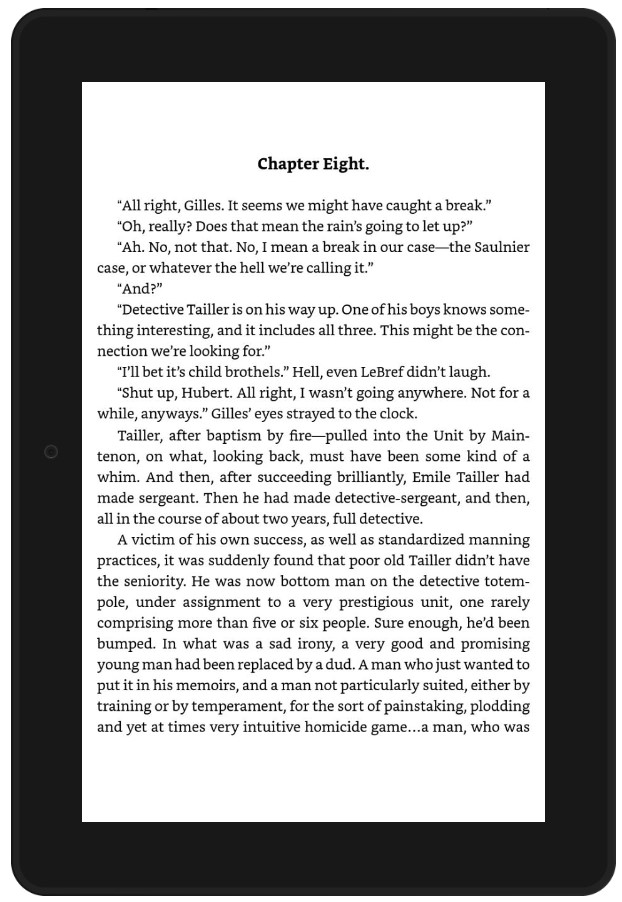
This is my book on the Lulu POD preview. It looks okay.
***

When publishing, I like to preview every page, and I have provided some pics of what that looks like.

I just converted to an audiobook on Google Play. It sounded surprisingly good for what I take to be AI. I saw that new option when I went to upload my new book. Once I got that done, I went back and had another look.

Here’s the thing. I have one hundred and fifty titles on Google Play, novels, collections and short stories, under five different pen names and in all kinds of genres.

All of that potential...revealed.

All I really hoped for was to finish my twenty-third novel, which took three winters to write and over which I have slaved and sweated and yeah, whatever. All one has to do is to click on a few buttons. All one needs is a fresh ISBN number for each new audiobook. All one needs is to find the original ebook marketing image, which seems to work well enough for an audiobook. All of a sudden, one has doubled the number of products, all of them available for the occasional customer to take a shine to and maybe spend the money.

This is Artificial Intelligence, possibly exploiting me but also a bright, shiny new tool, one that however briefly, can leverage my own productivity.

Those books and stories are already written. They already exist—all I have to do is to pick a voice, set a price, listen to a few short sections, edit some of the front matter, which is repetitive and not necessary.

All I need is a bit of time, a bit of time away from the regular, part-time job and running errands about town.

We'll see what happens with all these audiobooks, ladies and gentlemen...
***

Smashwords has epub downloads in something called ReadAloud, and I did download that (A Stranger In Paris), and I did listen to it. It’s not very good, which is why Google’s voices (and you can choose from several), kind of surprised me. With a long list of titles, I can use a female Aussie voice, for example, on a Constance ‘Dusty’ Miller story and a young American male voice for an Ian W. Cooper story.

It looks like I have my work cut out for me, what with all those ISBNs and cover images crowding my desktop and filling up my file folders.


END


Poor old Louis is on Google Play along with some pen-names.

See his art on Fine Art America.

Check out this other story here.


Thank you for reading.


Thursday, February 6, 2014

To Submit or Not to Submit?

Themes of Creation. Leonid Pasternak.


Louis Shalako


To submit or not to submit?

That might not even be the right question these days.

What to submit, and what not to submit, might be a better way of putting it.

So far this year I’ve been focusing on short stories, an art form in their own right.

The only way to master something is to do it, and when I run out of steam, only then will I worry about my next novel, (or novel #13.)

Other than blog posts, a poem, something unfinished, something ready to begin, (another blog post,) it looks like the one I just started working on is story number seventeen for 2014.

So here’s the question: should I submit it and keep on submitting it until it is sold, (according to Heinlein’s Rules) or should I just go ahead and publish it myself?

It’s not strictly an either-or question.

There is always a chance, right?

But think about it first. If there are fifty-one pro markets listed on Ralan.com, then those fifty-one markets probably get anything up to ten or twenty thousand submissions a month between them. It might be more—a lot more.

Do the math. Calculate the odds. I’ve got one new story, and maybe a dozen worth submitting. They’re already out there and many markets won’t accept multiple submissions. They don’t want to see the same story twice, either.

Right now, I have a handful of stories under submission. When I submit a story, it could result in a sale, although it is a hit-and-miss thing. It’s not even a question of quality or competence at some level. I just have to put the right story in front of the right editor, in the right genre, just when they’re looking for just that certain kind of thing. The right time and place sort of thing.

But I do submit stories in the Pro, Semi-Pro, (fifteen listings at time of writing) and Pay, (35 listings, mostly closed to submissions right now) as well as checking out token markets, looking for other markets and finding new lists independently. I’ve also checked out Mature markets, etc.

But here’s the thing.

Let’s say you’re not making any pro or big-bucks sales. Never mind if they’re listed with the SFWA or not. 

You need some pro sales to get into the SFWA, right?

How important is that? What does it actually do for you? Those have to be pro sales.

Are you going to let a good story go for five, ten or twenty dollars? Will you give it up for free and some kind of validation?

Are you looking for mere justification?

What does that get you? Publication, yes. Your story is even kind of safe for awhile—it’s safe from being published on the blog or being lost if the computer goes down. People can read it if it’s accepted, and maybe you really will be discovered.

But that story might not appear for a few months. When it does appear, they have a license for a stipulated period of time. Afterwards, your story might be archived on their site in perpetuity.

You might give all that up for five, ten or twenty dollars and the chance to say you got published.

And it doesn’t even help you get into the SFWA, either. Assuming that’s important to you.

So we have to make the comparison.

Let’s take a story I just wrote. It was 10,200 words. In that particular genre, there was nowhere to submit it, even to a minimal pay or token market. There wasn’t even any place to submit it for exposure, although, there is at least one historical fiction market listed on Ralan. But my word count was way over their limit. No point in submitting it there...

Part of the challenge was the nature of the material.

So, being too short for a book, and with nowhere to submit it, what was I supposed to do with it?

Answer: publish it. That even sort of follows Heinlein’s Rules, in the here and now—the Brave New World of Publishing.

Think about it.

Say it costs five or ten bucks for a cover. It took four and a half days to write, edit, format, find an image and make a cover, get an ISBN, etc. You need a blurb, right? It probably took a minimum of ten or twelve hours just in the writing time—it’s 10,200 words after all.

A story which would otherwise be useless is now in the store.

If it sells for $2.99 and ten or twenty of them leave the store per year, then that, honestly, sounds like peanuts. I admit that.

It is also something like twenty or forty bucks a year for a story that might have gone for even smaller peanuts. Over ten years that’s two hundred to four hundred bucks, for a nice little story that might have gone for exactly that much (once) in a professional sale at two to four cents a word.

And, I write a lot of stories. Do the math. Calculate the odds.

But consider those odds over the long term—the next ten to twenty years, when, arguably, I should be submitting that story, over and over again until it is sold.

But there's nowhere to fucking submit it.

Reprints are admittedly worth fifty percent of the original sale price. This holds true at four hundred dollars. It also holds true if you sell your story for five or ten bucks. There is a judgment call here, and you have to decide before publishing it yourself, just exactly what it is that you are risking.

Mike Resnick or Robert J. Sawyer can sell any story they write.

So far, I have not learned how to do that in that traditional sense—I have to rely on what few readers I can get!

It’s a whole ‘nother ball of wax.

I have never claimed that this is any easier than the traditional path.

It is merely the path that seems to be open right now, in this Brave New World of Publishing.

In the very early days of a long and distinguished career, we’re not risking that much, right? It depends on where you’re at and what you hope to achieve. It depends how much time you have left.

Now, assuming I have a story in science fiction, fantasy, horror, or mystery, maybe a little something in the romance or erotica line, then of course I would know where to submit it.

There are also ways of finding more markets.

Even then there is some kind of judgment call. If it’s talking cats, then one editor doesn’t want it, and if it’s vampires or werewolves, some other editor doesn’t like that. You might have already submitted a story or a book to all the markets that you can find in a genre.

Or maybe you just don’t care to keep looking.

Now, my next story, or number whatever for this year, has the sort of material that’s not going to make it into iTunes. There are themes of non-consensual sex in the story. If you read the submissions guidelines, you will see that in some markets they have very specific guidelines as to what they will and will not accept. Many magazines would not want to see this story.

So, again, write it, edit, format it…make a cover. Stir and repeat, right? And now another pen-name, has another new product, this one in an edgy, erotica-for-hetero-males sort of a way. It’s 5,000 words, took a couple of days to produce, and I had total creative control over something that has social redeeming value, but might be offensive to some readers.

Essentially.

And I can mark it at $2.99, give discount coupons on Smashwords, set it for free sometimes, whatever it takes to move a few copies of that story on the long list of bookselling platforms…a list that will grow over time.

Some other story might be a good candidate for the blog ( or, an unpublished book of dubious nature could be published as a serial.) Or as a free promotional book or short story. It still only costs five or ten bucks for the cover.

At some point down the road you get to set a price on it and set up your next freebie.

Once you’ve paid for the cover image, it’s all gravy, folks.

If I write three or four stories for one pen-name, then at some point I write one specifically for a free giveaway. When I’m working in a specific genre, I generally know, or soon figure out, who I’m writing it for, whether it’s for the blog, my lady-erotica writer or my thriller guy. Sooner or later they’ll all have pretty long lists of titles.

Everything involves a judgment call and some assessment of the benefits, the rewards and the costs.

Other than that, you put in the time, you do the work.

Have fun doing it and you’ve got the world by the ass.

That’s what it’s all about, ladies and gentlemen.

It's all about writing things and putting them out there into the world.


END


Wednesday, January 15, 2014

Word Count: You Gotta Do What You Gotta Do

"You gotta do what you gotta do, Baby."


by Louis Shalako


Word count is important because it shows whether you are working or not.
I like having ideas. When I get an idea, I write the story.

***


So how do you create a word count, big or small, for better or worse?

Allow me a bit of a brag.

So far in 2014 I have written eight stories and I have another 2,000 down on the next one. It’s only January fifteenth.

Those eight stories are at least 25,000 words and probably more. One of the stories was 4,300 words, and the shortest was still about 1,650. I’m writing science-fiction, erotic romance and even a spooky adventure snuck in there.

I’ve got two more story ideas. I create the file, name it and leave it on my desk-top. When I get a story done I submit it, (or post it on my blog) and at some point I stick it in a folder. I don’t always submit them right away. Right now I have three or four un-submitted stories, which have never appeared anywhere before. I don’t quite know what to do with them.

I’ve got four new ones under submission plus a handful of previous stories under review by pro, semi-pro or at least ‘pay’ markets.

In the past, I have sold the odd story.

I make no other claims.

Every so often I do give one away, for exposure. If nothing else, I can tweet about it, and post it on Facebook.

The story I am working on now will be worked on tomorrow. I reckon I can finish it up tomorrow. Why not? And then there are the next two stories. Got nothing better to do…

What I need more than anything is ideas.

When I run out of ideas, there are plenty of administrative things to do, but nothing is as satisfying as actually working with a story from beginning to end.

That’s what really does it for me.

I guess that’s why I’m here.

***

So in other words we work at it. It really is that simple.

We make the time. The actual writing is probably only good for two to four hours a day.

I have written two blog posts, (now three) one of which has been published, (now two) although the other needs a bit of work.  That one’s about Control.

I have formatted a new 5,000 word story for publication, complete with front and end matter, designed a book cover (marketing image) for it, got an ISBN number, written the blurb, etc.

In order to get the marketing image, I had to shop for it and then make ‘the cover’ using a simple paint program.

For the last little while, I’ve been uploading books to Google Play and Google Books. I do one or two a day as time permits.

One of my pen-names has a nice story coming out very soon. It will be published to Smashwords and all of their distribution channels, Kindle and OmniLit. Uploading a book can take ten or fifteen minutes. Everything takes a certain amount of time.

Other than that, I try to keep busy.

That’s how I get my word count.

I wouldn’t say it was easy,

I wouldn’t say it was hard.

You gotta do what you gotta do.


END